The Art of the Closed Door: How Deliberate Exclusion Defines the World's Most Exceptional Experiences
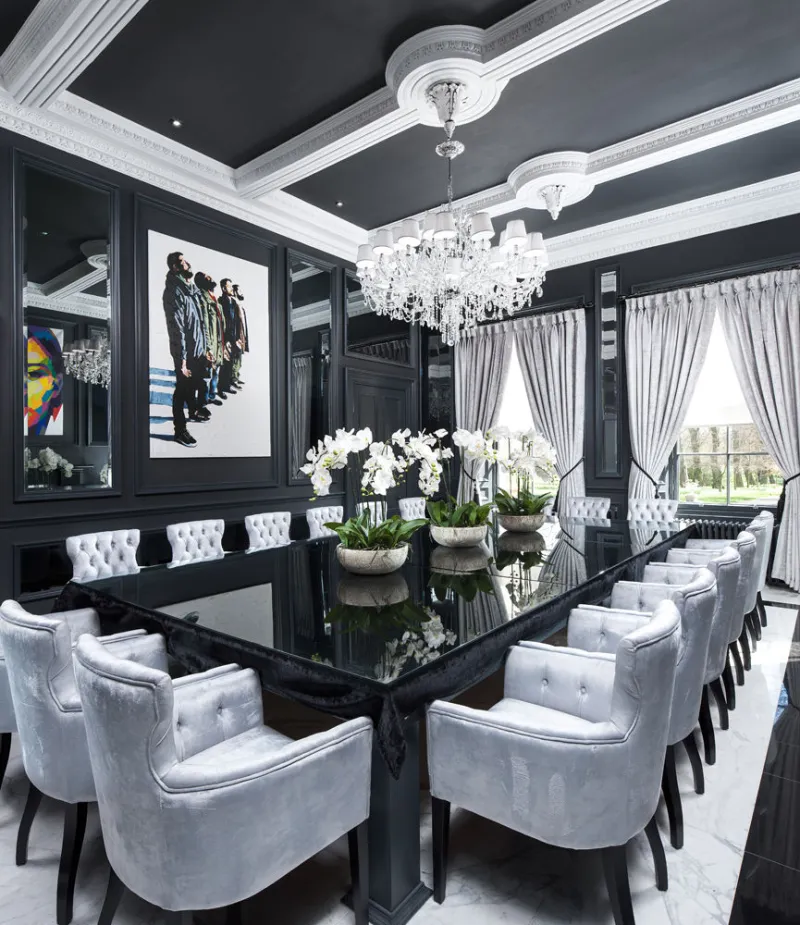
Photo: Sue pile, CC BY-SA 4.0, via Wikimedia Commons
There is a particular kind of quiet that descends upon a room when everything unnecessary has been removed. No ambient noise, no superfluous conversation, no distraction from the central experience. Musicians have long understood that the rests between notes are not empty space—they are the very framework that gives melody its meaning. The world's most distinguished brands and service providers have arrived at a similar understanding: what they choose to exclude is as consequential as what they choose to offer.
In an era defined by relentless expansion—more SKUs, more locations, more subscribers, more reach—a small and deliberate countermovement has taken root among institutions that refuse to confuse volume with value. These are the establishments, the ateliers, the private clubs, and the hospitality houses that have built their reputations not on the breadth of their welcome, but on the precision of it.
Scarcity as a Design Principle, Not a Marketing Device
It would be tempting, and somewhat cynical, to interpret limited availability as a calculated manipulation of consumer desire. Artificial scarcity, after all, is a well-documented tactic in the broader luxury market. But there is a meaningful distinction between manufactured shortage and principled restraint—and discerning consumers increasingly know the difference.
Consider the private dining establishments that operate without a public reservation system. Several of the most celebrated chef's tables in cities like New York, San Francisco, and Chicago seat fewer than a dozen guests on any given evening and extend invitations through personal networks rather than third-party platforms. This is not theater. The reasoning is structural: a kitchen operating at intimate scale can source ingredients with greater specificity, apply techniques that are impractical in larger volumes, and deliver a coherence of vision that dissipates the moment the dining room doubles in size.
When a chef knows every guest by name—sometimes by palate—the experience transforms from hospitality into something closer to collaboration. The closed door, in this context, is not a barrier. It is a condition of possibility.
The Bespoke Principle: Saying No to Protect the Yes
In the world of bespoke services—whether tailoring, interior design, or financial advising—the most accomplished practitioners often maintain deliberately small client rosters. A Savile Row-trained tailor working independently in the United States may accept no more than forty clients annually. A highly regarded interior designer with a national reputation may limit active projects to six or seven at a time. These are not capacity constraints born of insufficient ambition. They are choices made in service of craft.
The mathematics of excellence are unforgiving. Genuine attention is a finite resource. When a practitioner takes on one more client than their process can thoughtfully accommodate, the resulting dilution does not distribute evenly—it concentrates at the margins, eroding the very qualities that made their work worth seeking in the first place.
This is the paradox at the heart of principled exclusion: the act of saying no to some is, in its most honest form, the most sincere possible yes to those already within the relationship. It is a commitment that the standard will not be compromised, that the experience will not be rationed, and that the attention being offered is whole rather than divided.
Curated Access in American Luxury Hospitality
American luxury hospitality has quietly embraced this philosophy in ways that distinguish the truly exceptional from the merely expensive. The most sought-after ranch retreats in Montana and Wyoming, for instance, operate on a cabin-count model that would strike a conventional hotelier as commercially irresponsible. Properties with thousands of acres of land and the operational capacity to host far larger groups deliberately cap their guest count to preserve the integrity of the landscape experience—and, more pointedly, to ensure that staff-to-guest ratios remain at levels where genuine service is possible.
At these properties, the experience is not defined by what is available, but by what is protected. Fly-fishing access remains uncrowded. Guides remain unhurried. Meals are timed to the rhythm of the guests present, not to the logistical demands of a full house. The closed door—the finite number of available weeks per season, the waitlist measured in years rather than weeks—is the mechanism by which the experience retains its character.
Similar principles govern the most respected private members' clubs in cities like Chicago, Boston, and Washington, D.C. The clubs that have endured for generations are not those with the largest memberships, but those with the most carefully considered ones. Membership committees exist not to exclude arbitrarily, but to steward a culture—to ensure that the community forming within those walls is one in which every member is genuinely enriched by the presence of the others.
What Exclusion Communicates to Those Who Enter
There is a psychological dimension to principled exclusion that is worth examining honestly. When an individual gains access to an experience that is genuinely difficult to obtain—not because of price alone, but because of selectivity—the quality of their engagement with that experience changes. Attention sharpens. Appreciation deepens. The experience is received with a presence that more casually accessible alternatives rarely inspire.
This is not snobbery. It is the natural human response to rarity that is earned rather than purchased. When a guest at a private dining table understands that the evening's menu was composed with their specific preferences in mind, that the ingredients were sourced in anticipation of their visit, and that the chef will spend the evening in their company rather than managing a dining room of fifty, the meal becomes something other than dinner. It becomes an event in the truest sense—singular, unrepeatable, and wholly attended to.
The brands and institutions that understand this dynamic are not creating exclusivity as a feature. They are recognizing that genuine quality, delivered without compromise, is inherently selective. The limitation is not the product. The limitation is the evidence of the product's authenticity.
The Standard That Selectivity Upholds
At SuperPerfect, the pursuit of excellence begins with an honest accounting of what excellence actually requires. It requires constraint. It requires the courage to define a boundary and hold it, even when expansion would be commercially convenient. It requires the understanding that a standard, once compromised, is not a standard—it is merely a preference.
The world's most enduring luxury institutions have not survived by becoming all things to all people. They have survived by becoming one thing, completely, to the people for whom that thing is everything. The silence between the notes is not absence. It is the condition under which the music can be heard at all.
For those who seek experiences and products defined by genuine excellence rather than the performance of it, the closed door is not an obstacle. It is, quite often, the most reliable signal that something worth entering lies on the other side.