The Art of Anticipation: Why True Connoisseurs Refuse to Rush the Acquisition
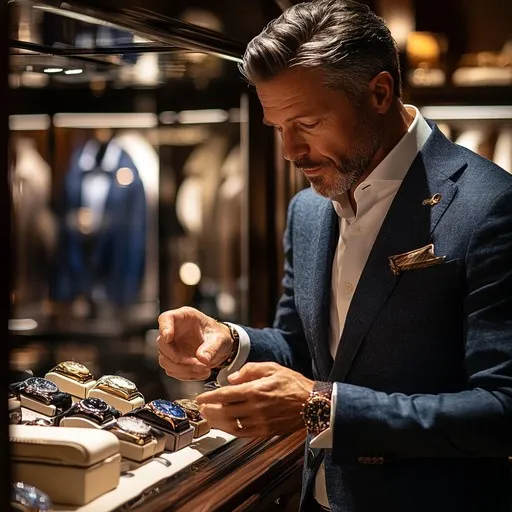
Photo: elegant collector examining luxury watch in sophisticated private library, via images.stockcake.com
There is a particular kind of pleasure that no credit card can accelerate. It arrives slowly, accumulates quietly, and culminates in a moment of acquisition that feels less like a transaction and more like a resolution. Among the world's most refined collectors—those who pursue Burgundy vintages with the same rigor they bring to Patek Philippe waitlists—this pleasure is not incidental. It is the point.
The culture of slow acquisition has emerged as one of the defining postures of elevated taste in contemporary America. While the mass market races toward same-day delivery and frictionless checkout, a quieter movement is unfolding in cellars, private clubs, and the notebooks of serious collectors: the deliberate, strategic embrace of waiting.
The Waitlist as a Statement of Values
To the uninitiated, a multi-year waitlist for a wristwatch or a decade-long allocation list for a sought-after Napa Valley wine producer might seem like inconvenience dressed in prestige. But those who have navigated these systems understand something more nuanced: the waitlist is itself a form of curation.
When a collector places their name on a list for a hand-finished timepiece from a small Swiss atelier, or secures an allocation with a Sonoma winery producing fewer than 800 cases annually, they are not simply queuing. They are signaling an orientation toward quality that transcends impulse. They are, in a very real sense, choosing the object before it is theirs—and that choice, made without the immediacy of possession, is among the purest expressions of genuine preference.
"Waiting clarifies desire," observes one longtime collector of American studio furniture who has spent years cultivating relationships with craftspeople whose commissions run eighteen months to three years out. "When you cannot have something immediately, you are forced to ask whether you actually want it—or whether you simply wanted the feeling of getting it."
This distinction matters enormously. The collector who waits has, by definition, passed a test of intentionality that the impulse buyer never encounters.
Scarcity, Authenticity, and the Psychology of the Long Game
The psychology of scarcity is well-documented, but its most sophisticated practitioners understand that it operates differently at the upper registers of the market. For truly discerning consumers, scarcity is not a marketing tactic to be suspicious of—it is an honest reflection of what genuine quality requires.
A master violin bow maker in Boston who produces perhaps forty bows per year is not manufacturing exclusivity. The limitation is structural, inherent to the craft. The same is true of the Bordeaux château whose terroir yields a finite quantity of exceptional fruit, or the independent watchmaker whose movements require hundreds of hours of hand-finishing. In each case, the waitlist is simply the market's honest response to the arithmetic of excellence.
This authenticity is precisely what separates meaningful scarcity from manufactured urgency. Discerning collectors have developed a finely tuned ability to distinguish between the two—and they reward the former with extraordinary loyalty.
The psychological benefits of the wait itself are also worth examining. Research in behavioral economics has consistently shown that anticipation generates its own form of pleasure, often comparable to—and sometimes exceeding—the satisfaction of the outcome. For collectors who understand this, the months or years spent tracking a commission, following a vintage through its barrel aging, or monitoring an atelier's production calendar become an enriching dimension of ownership that begins long before the object arrives.
Building the Anticipation List: A Practical Philosophy
Among serious collectors, the maintenance of what some call an "anticipation list"—a carefully considered register of objects being pursued across varying time horizons—has become a discipline in its own right. Unlike a wish list, which is essentially a catalog of desire, the anticipation list is an active document, informed by research, relationships, and a clear sense of one's own evolving aesthetic.
The most thoughtful collectors approach this list with genuine rigor. They study the makers behind the objects. They visit studios, attend tastings, correspond with craftspeople. By the time an object is finally acquired, they often know more about its provenance and production than most casual buyers could learn in a lifetime of ownership.
This depth of engagement transforms the nature of possession itself. The collector who has spent two years learning about the provenance of their hand-knotted rug—the region, the dye traditions, the specific weaver—inhabits that object differently than someone who selected it from a catalog. The waiting period, in this sense, is not dead time. It is the period during which the relationship between collector and object is actually formed.
The Social Currency of Restraint
In American culture, conspicuous consumption has long served as a primary vehicle for social signaling. But among the most sophisticated strata of collectors and connoisseurs, a subtle but significant shift has occurred. The ability to wait—to demonstrate that one's acquisitions are the product of sustained intention rather than liquid enthusiasm—has itself become a form of distinction.
This is, in part, a reaction to the democratization of luxury. When premium goods become broadly accessible, the markers of genuine refinement necessarily evolve. The object alone no longer suffices. What matters increasingly is the story of how it was acquired, the relationships cultivated in its pursuit, and the evidence that its owner possesses the patience and discernment to engage with quality on its own terms.
In this light, the waiting room is not a place of passive endurance. It is an arena of active cultivation—of taste, of knowledge, of the kind of measured judgment that distinguishes the true connoisseur from the merely affluent.
Excellence Rewards Those Who Earn It
The slow acquisition movement, at its core, reflects a profound truth about the nature of superior quality: it cannot be rushed. The wines that reward decades of cellaring, the timepieces that improve with age, the furniture built to outlast its owner—these objects exist in a different temporal register than the mass market. To engage with them authentically is to accept their terms.
For those willing to enter the waiting room, the reward is not merely the object at the end of the queue. It is a fundamentally different relationship with quality itself—one defined not by consumption, but by appreciation; not by acquisition, but by understanding. That, perhaps, is the most refined status symbol of all.