Less, Perfected: How America's Wealthiest Are Choosing Depth Over Accumulation
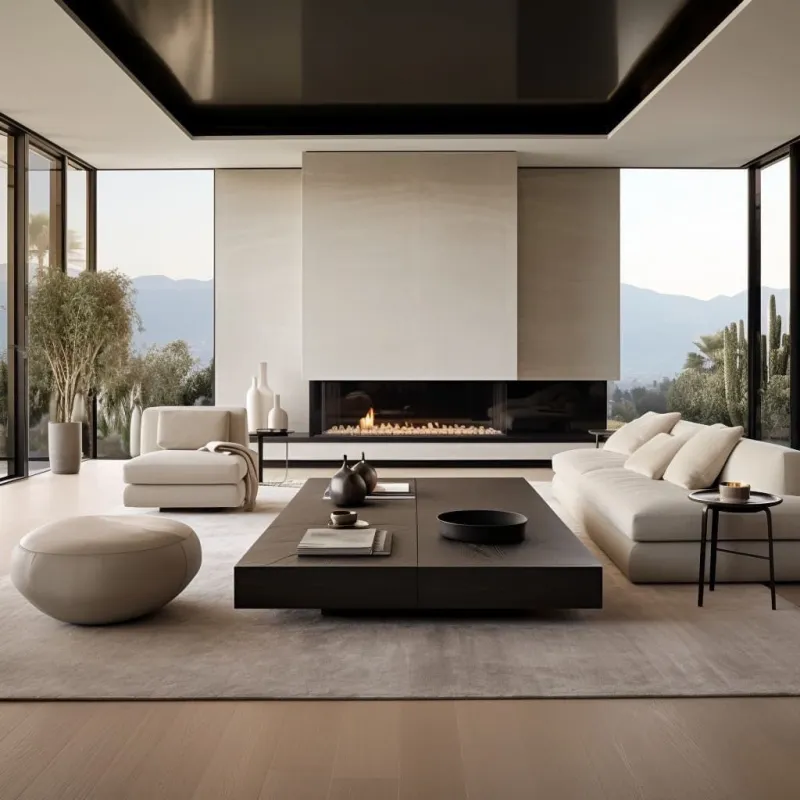
Photo: minimalist luxury interior single statement object refined home decor, via i.pinimg.com
For most of the twentieth century, the visual grammar of American wealth was unmistakable: expansive estates, multiplying vacation properties, garages housing vehicles for every occasion, and wardrobes that required dedicated rooms to contain. Accumulation was the language of success, and abundance was its most legible dialect.
That grammar is being quietly, deliberately rewritten.
Among the wealthiest segment of the American market — individuals with net worths north of $30 million — a countercultural movement is gaining momentum. Its adherents are not reducing their standards. They are, in fact, raising them. What they are reducing is the number of objects to which those standards apply.
The Burden of More
The psychological research on this phenomenon has been accumulating for over two decades. Barry Schwartz's foundational work on the paradox of choice established that beyond a certain threshold, additional options do not increase satisfaction — they diminish it. Decision fatigue, the cognitive cost of managing complexity, and the persistent sense that an unchosen option might have been superior all extract a toll that accumulation conceals but cannot eliminate.
For high-net-worth individuals, the burden of extensive ownership manifests in concrete, practical terms. A collection of fourteen watches requires maintenance schedules, insurance riders, and secure storage. A wardrobe of three hundred garments demands organizational systems and periodic audits. A portfolio of five residential properties involves property managers, local legal compliance, and the recurring friction of logistics. The administrative overhead of abundance, at sufficient scale, becomes a part-time occupation.
"There is a point," one private wealth advisor with a client base concentrated in New York and San Francisco observed, "where your possessions begin to manage you rather than the other way around. Our most sophisticated clients have recognized this, and they are responding to it."
Curation as the New Currency
What is emerging in its place is a philosophy that might be described as radical selectivity. Rather than acquiring broadly, an influential cohort of affluent Americans is channeling their purchasing power into a dramatically smaller number of objects — each chosen with exceptional deliberateness, each representing the absolute apex of its category.
A single bespoke suit from a Savile Row tailor, commissioned during a visit to London and maintained indefinitely, rather than a rotating seasonal wardrobe. One handcrafted timepiece that will outlast its owner, rather than a display case of fashionable complications. A primary residence designed and furnished with uncompromising attention to every detail, rather than multiple properties that dilute both financial investment and personal connection.
This is not deprivation. It is, by any meaningful measure, the opposite. The individual who owns one exceptional object has, in a real sense, more of it — more attention available for it, more appreciation of its qualities, more intimate knowledge of its character — than the individual who owns twenty adequate substitutes.
The concept has a philosophical lineage. The Stoics wrote extensively about the relationship between desire, ownership, and freedom. The Japanese aesthetic principle of ma — the productive use of empty space — has influenced generations of designers who understood that absence can be as meaningful as presence. What is new is its emergence as a dominant aspiration among a demographic that has, by definition, the resources to choose otherwise.
The Market Responds
The luxury industry is paying close attention. Several heritage brands have begun positioning their offerings explicitly around the concept of singular, defining acquisitions rather than seasonal collections. Hermès has long operated on the principle that its most coveted pieces should be difficult to obtain — scarcity, in this framework, is not a supply chain problem but a design feature that preserves the object's meaning.
Bespoke and made-to-order services across categories — from residential architecture to automotive, from tailoring to timepieces — are reporting increased demand from clients who are consolidating rather than expanding. The commission of a single, perfectly realized object, built to the client's exact specifications and intended for long-term ownership, is increasingly preferred to the acquisition of multiple ready-made alternatives.
This shift is also visible in the real estate behavior of ultra-high-net-worth Americans. After years of portfolio expansion, a notable segment is divesting secondary and tertiary properties in favor of investing more deeply in a primary residence. The result is homes that function less as status signals and more as environments of genuine, daily excellence — spaces where every material and every detail has been considered with the same rigor previously applied to a financial portfolio.
The Psychology of Intentional Ownership
What drives this reorientation is not, at its core, financial logic — though financial logic supports it. It is psychological. The experience of owning something truly exceptional, something that has been chosen with full deliberateness and maintained with real care, is qualitatively different from the experience of owning many things casually.
Researchers studying consumer behavior among high-income individuals have identified what they term "object intimacy" — a depth of relationship with a possession that develops only when attention is not diluted across a large collection. The person who has worn the same perfectly fitted jacket for a decade knows it differently than the person cycling through a seasonal rotation. That knowledge carries its own form of satisfaction, one that novelty cannot replicate.
There is also a dimension of identity at work. As the cultural markers of wealth have become increasingly accessible — luxury brand logos, premium automotive badges, and business-class travel are all available to a far broader economic range than was true a generation ago — the ultra-wealthy have sought differentiation through means that cannot be easily replicated. Depth of curation, the evidence of genuine connoisseurship, and the visible absence of unnecessary accumulation have become, paradoxically, among the most sophisticated signals available.
Perfection Over Proliferation
The implications for how discerning Americans approach consumption are significant. The question being asked by this leading cohort is no longer "What else might I acquire?" It is "What, precisely, is worth owning?"
That is a harder question. It demands genuine knowledge of quality, patience in selection, and the willingness to invest substantially in objects chosen to last. It requires resisting the cultural pressure toward novelty and the comfortable illusion that more options represent more freedom.
But for those willing to engage with it seriously, the answer redefines the relationship between ownership and satisfaction. At SuperPerfect, we hold that the pursuit of excellence is, at its heart, a practice of elimination — of removing the adequate, the approximate, and the merely acceptable until only the genuinely exceptional remains. The wealthiest Americans, it appears, are arriving at the same conclusion.